James Hunter

Tuesday, May 19, 2015

San Jose Water Company Water Rationing 15 June 2015

Updated 05/28/2015


The Mercury News published table showing the water rationing effective 15 June, 2015, for customers of the San Jose Water Company (SJWC). The State Water Resources Control Board adopted a resolution to reduce water consumption by 25%, statewide. This was then used as the basis of a resolution by CPUC and sent to the water utilities, including San Jose Water Company (SJWC).

This is more difficult for SJWC customers to understand, as our SJWC is bimonthly, billing is by two month periods. My water bill (redacted to protect personal info) is used as an example:
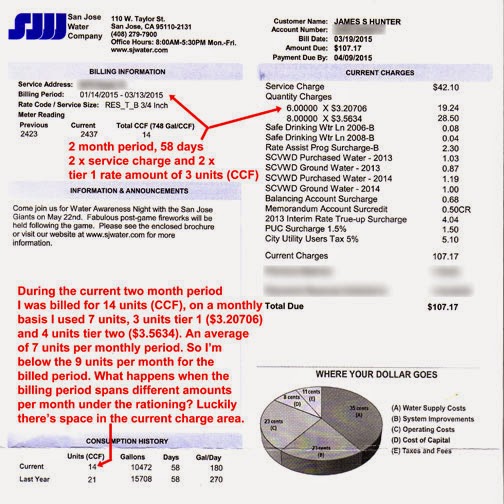

Blogger comment: Yes, I also reduced my water consumption by (21-14) = 7,  7/21 =  33% savings over the same period in 2014 and I'm 4 units below the allocation target of 18 units for the 2 month period. I always thought the "Brown is the new Green" was coined by the Governors re-election team. I'm pretty conservative, but he's stepped up to most challenges....................except may be CPUC.  I'd say water under the bridge, but we may not have enough to spare.
  • The penalty charges are also a bit confusing, current rates then in effect apply:
    • 0-3 units (CCF)  -  $3.20706
    • 4-18 units (CCF) - $3.56340
    • 18+ units (CCF)  - $3.91970
  • The 30% difference between your current used units and the monthly 2013 unit average use the applicable additional surcharge:
    • $3.56340 per unit penalty added to the base current per unit charge of $3.56340, you would pay $7.13 per unit
  • All units used above the the applicable monthly 2013 average will pay the base applicable unit charge $3.56340 (currently for units used from 4-18) an added penalty of $7.12680  per unit or apparently $10.69 per unit (CCF).

Q: What are the excess drought surcharges and how are they calculated? A: Most residential customers are billed bi-monthly. You will be charged at the current rate structure for all the units consumed. In addition to the current charges, each unit of water in excess of your allocation target will be charged as follows:

  • Drought Surcharge 1 (DS1): Excess consumption over allocation up to the 2013 monthly average will be charged at $3.56 per unit 
  • Drought Surcharge 2 (DS2): Excess consumption over the 2013 monthly average will be charged at $7.13per unit  
What SJWC is trying to say, you get 70% of the 2013 average month water usage or a minimum of 9 CCF at the current rates for that month (red flag - your price is going up!). If you use more than 9 CCF up to the 2013 average usage you pay the basic current rate per CCF (unit), plus a drought surcharge $3.56 (red flag you will pay $7.12 per CCF or more if the base rate per CCF is higher). If your use exceeds 100% of the 2013 monthly average, you pay the basic current rate per CCF (unit), plus a drought surcharge $7.13 (red flag you will pay $10.69, more if there is a basic rate increase per CCF).

Let's see what we would be paying per acre foot, keep in mind SJWC buys 1 acre foot from Santa Clara Valley Water District for about $875.  1 acre foot of water equals 436.5 CCF: 
$875 one acre foot / 436.5 CCF (acre foot of water) = 
$2.00 CCF (unit) compares with a unit over 100% 
with Drought Surcharge (Penalty) $10.69 or means
an acre foot with all penalties would cost
$10.69 x 436.5 = $4,666.18, if 1% of the homes
use 1 unit more than 100%, it would be 2,000 units
2,000 x $10.69 = $21,380
Blogger's note: I was so surprised I used a different calculator - this is getting to be 
real money and we need to have a very clear statement of where it will go and what it 
will be used for. It will only take 2,000 homes to go over, 100% allocation, by one CCF
(unit) per month to get $21,380. We can see the Drought Surcharge can be a lot of 
buck$. We can also see the markup SCVWD - $875 AF to SJWC $4,666
Now that we have an idea of the penalties that are applied above the average allocation (ration) by month let's look at where the money goes and how it will be used, as indicated in the SJWC FAQ.
Q: What will happen to the drought surcharges?
A: The surcharges will be deposited in a drought account authorized by the California Public Utilities Commission to track lost revenues from conservation. The amount collected will offset future surcharges as a result of conservation efforts.  
Blogger comment: Will it be used to guarantee SJWC gets it's 8.08% profit! I don't think the answer (A:) is thorough and complete? Since ORA is opposed to the annual 2,000 free toilets and installation added conservation option in the new general rate increase, is it possible that SJWC is collecting too much penalties? California Water Systems appears to be using a lower penalty rate and appears to follow the suggested Stage 3 Drought Guideline:


SJWC ADVICE LETTER NO. 473, Page 6 
"The proposed Schedule 14.1 further provides that all monies collected by the utility through surcharges or fees shall be booked to the WRAM or a similar memorandum account to offset recovery of lost revenues and that all expenses incurred by the utility to implement Rule 14.1 and Schedule 14.1 that have not been considered in a General Rate Case or other proceeding shall be recoverable by the utility if determined to be reasonable by Commission.
These additional monies shall be accumulated by the utility in a separate memorandum account, for disposition as directed or authorized from time to time by the Commission." 
Oops, SJWC doesn't seem to have a WRAM quite yet, they have requested a WRAM again in the current pending General Rate Case 1501002, but they do have a MCRAMA currently.  SJWC feels because other utilities when Mr. Peevey was the CPUC President got full revenue decoupling from operation/cost WRAMs they should get a WRAM, as well . More in a separate post to this blog soon.

Notice for SJWC ADVICE LETTER NO. 468
"San Jose Water Company (SJWC) has filed Advice Letter No. 468 (AL 468) with the California Public Utilities Commission (CPUC) requesting authorization to recover the accumulated balance in the Mandatory Conservation Revenue Adjustment Memorandum Account (MCRAMA) of $9,566,814, or approximately 3.4% of authorized revenue. 
Approved, the requested increase would become effective on or about June 15, 2015. The CPUC authorized SJWC to establish a MCRAMA to track the revenue impact of mandatory conservation upon SJWC’s quantity revenue resulting from mandatory conservation instituted by the State of California and the Santa Clara Valley Water District. As directed by the CPUC’s Water Division, the increase will be recovered via a surcharge on the existing quantity rate for a period of 12-months from the date of CPUC approval."
In other words the accrued conservation costs, will show up, in your water bill, starting in June 15, 2015 as a $0.1798 surcharge.  My posting to this blog, "SJWC Rate Increase, June 1, 2015" looks at this increase and the actual cost to you.

Apparently SJWC has spent $9,566,814 on "conservation" as required by the State of California and the Santa Clara Valley Water District. The interested SJWC customer may be interested in reviewing, "Advise Letter 468" (AL 468), it appears that more is included in the $9,566,814 than simply "conservation". The complete text of the Advise Letter 468 is available. please click to view.  While Notices based on Advise Letter 468 seems focused on conservation (that is a lot of blue buckets, pamphlets, customer meetings, lots of aerators, square feet of turf, etc.), but I personally would like to see a breakdown on the actual conservation expenses. Since others numbers indicate the conservation efforts to date don't seem to be very effective. AL 468 seems oriented to collecting the under payments from past years, cleaning up and consolidating accounts to collect balances in various accounts so that the 8.08% CPUC approved profit is achieved and preparing for the implementation of a full revenue decoupling WRAM. Conservation and drought appear to be a fog obscuring the likely purposes.


Collected penalties will be held in an account MCRAMA or worst case in a new WRAM and used to pay conservation related expenses, it's not clearly addressed if there is an amount larger that the the identifiable conservation expenses? I suspect if the conservation costs are covered any left over will be used to insure that the CPUC annual profit currently 8.08% is achieved.

There will be a public hearing I encourage you to attend. SJWC ADVICE LETTER NO. 473, Page 6 :

The Drought Procedures require that “A public hearing shall be help prior to a utility adding
Schedule 14.1 to its tariffs.” SJWC has planned for a public meeting as shown below:
THURSDAY, MAY 28, 2015
7:00 PM
ROTARY SUMMIT CENTER
88 SOUTH 4TH
STREET
SAN JOSE, CA 95112 

More information about the ROTARY SUMMIT CENTER is available at:
http://www.clubrunner.ca/Data/5170/3975/images/Rotary_Summit_Center.pdf

Parking, Evening Rate Enter After 6pm Exit by 6am  $5.00
http://sanjoseparking.spplus.com/san-jose-44-south-4th-street-parking.html#Tab_coupon-rates

If you need handicap parking or feel $5.00 parking fee is not appropriate to a public hearing send email to: 

Regulatory Affairs San Jose Water Company
110 West Taylor Street San Jose, CA 95110 
Fax 408.279.7934 
Regulatoryaffairs@sjwater.com

Request "Validation" of your parking ticket to allow you to attend the SJWC public hearing.

Sunday, May 10, 2015

Homeserve USA (HEIS) and BBB Accreditation and A+ Rating

I appreciate all comments, feedback and suggestions and a recent comment by "Michael K" (privacy respected). I was encouraged by his recent experience and his neighbors. I hope my efforts, on this blog, have encouraged and motivated HEIS (aka Homeserve USA, Home Emergency Insurance Solutions, etc.) to provide improved service and coverage to their customers.

------------------------------------- Comment on Blog ------------------------------------------
Michael K********May 8, 2015 at 12:51 PM
It might be time to update your blog... I just looked up HEIS on the web site of the CT. BBB and its rating (as of 2014) is A+. I've gotten several of these letters over the last couple of years and thrown them all away. It's clear to me that it's not from the water district, but I can see how some people might be deceived. Plus, all the alarmist text makes it sound fishy. Then my next door neighbor had a leak. He had previously gotten the insurance. His $2800 repair was completely covered. They even upgraded his pipe from galvanized to copper at no cost. I think it's important to separate the criticism about the deceptive advertising from the criticism about the coverage itself. While I agree that the advertising should be more transparent, the coverage is pretty well defined, albeit admittedly of narrow scope. Based on my neighbor's experience I plan to get the coverage, as our houses are 50+ years old, and like a prior poster said - $59 a year is cheap peace of mind.
ReplyDelete
Replies


  1. I'm very pleased to hear they are improving not only their BBB rating, but providing excellent service to your neighbor. Several years ago that didn't seem to be true. I hope my blog helped motivate some of the improvement. I will check their BBB rating and see what comments are being posted in the press and update the blog, as appropriate.
-------------------------------------- End Comment on Blog -------------------------------

I checked Michael K's reference to BBB (Better Business Bureau) and a rating of A+, in 2014. Links from excerpts are provided to the BBB web site referenced by Michael K, so content can be verified.

I found the following that might place the comment in perspective:
  • HomeServe USA Corp.BBB ACCREDITED BUSINESS SINCE 2/3/2014
  • Since Michael didn't provide a general location, his, other than CT (Connecticut) BBB, I have to assume the service and insurance claim occurred near Norwalk, CT. or did it occur someplace else?

BBB Accredited since 2014 for 1 year of continuous accreditation. 

BBB has determined that HomeServe USA Corp. meets BBB accreditation standards, which include a commitment to make a good faith effort to resolve any consumer complaints. BBB Accredited Businesses pay a fee for accreditation review/monitoring and for support of BBB services to the public.  

BBB accreditation does not mean that the business' products or services have been evaluated or endorsed by BBB, or that BBB has made a determination as to the business' product quality or competency in performing services. HomeServe USA Corp. affirms that it meets and will abide by the following standards. 

"The customer review(s) below are un-filtered. These positive and negative reviews are not used in the calculation of the BBB Rating. If you wish to file a complaint and request a resolution to your issue please click here. This customer review section is not BBBs complaint resolution system. Customer Reviews are the subjective opinion of the individual who posted the review and not of Better Business Bureau. A customer review is not posted on a business if a BBB complaint on the same issue(s) is also filed. BBB cannot guarantee the accuracy of any customer review and is not responsible for the content of any customer review. Public comments are not customer reviews." 

It appears that over the last year the Homeserve USA BBB accreditation and rating appear to be misleading. The reviews are quite negative , Customer Experience-Negative 80% and Customers will Recommend - Negative- 86.7%.
  • It should also be noted that complaints and reviews are different things to BBB. The reviews cover the period of accreditation - 1 year. The complaints appear to cover roughly 3 years? There were 302 "complaints", of which 33 were not "customer not satisfied with business response", roughly 11% of the customers were dissatisfied. I suggest the interested reader read the, "Complaint Breakdown by Resolution". You can look at the complaints which are redacted to protect complainants privacy.There is also a link to the BBB Closure Definitions. It appears to me there is a bias towards closing complaints? Readers comments are appreciated.

Some conclusions


It's really hard to determine if there has been an improvement in Homeserve USA customer service/support, what does the A+ rating, new since 2/2014, really signify since it doesn't seem to represent the quality/value of the product or service? BBB evaluates a published set of criteria for rating a business which includes a fair and reasonable effort to resolve customer problems, honest advertising, etc.

BBB has also published a chart of customer complaints by type, display by clicking on "http://www.bbb.org/connecticut/business-reviews/water-and-sewer-line-protection/homeserve-usa-corp-in-norwalk-ct-87067998/complaints" then click the text link "View Complaints Summary by Type Pie Chart on HomeServe USA Corp", to display this pie chart:


It seems obvious that Homeserve USA needs to work on "Problems with Product and Service" and Advertising/Sales, which are a bit over 82% of customer complaints.

As a result of spending some time evaluating what the BBB Accreditation and the A+ rating that Michael K pointed out in his posting, I decided to try to find a bit more about Michael K. I should point out I've been working in the computer industry since 1967 and an Internet user since 1983, so I'm reasonably aware of publically available tools and how to use them for research. I found a Michael K who may have submitted the comment to this blog, was apparently employed by a California County in their IT Department, the County has a water district, the water district is a partner of Homeserve USA and gets compensated by Homeserve for each policy sold.  I hope that Michael K reads this and clarifies his comment a bit. Keep in mind Ian Fleming's novel Goldfinger, Moscow Rules slightly paraphrased "Once is an accident. Twice is coincidence. Three times may be a deliberate action". Just a guess that I hope is incorrect. Remember, "Trust first then try to Verify".


Contact BBB if you have a complaint about Homeserve USA (AKA Home Emergency Insurance Solutions (abbreviation HEIS), Home Serve HomeServe. Please click on the link below:

https://www.bbb.org/consumer-complaints/file-a-complaint/get-started


You may also submit a review to BBB regarding your experience as a customer of  Homeserve USA (AKA Home Emergency Insurance Solutions (abbreviation HEIS)Home Serve HomeServe. Please click on the link below:


I encourage customers, prospects and advertising recipients of Homeserve USA (AKA Home Emergency Insurance Solutions (abbreviation HEIS), Home Serve HomeServe. To submit either a complaint or review, as is appropriate.

Monday, May 4, 2015

SJWC Rate Increase, June updated to 15th, 2015


Did you receive this Public Notice or read it in the San Jose Mercury News? The entire text of the CPUC AL 486 request is available on the SJWC web site, but is hard to find. I found it by doing a search on "CPUC", on the web site, as there didn't appear to be easily found link in the general pages.

This rate increase be a surcharge on your SJWC bill, in a separate line item:
Apparently this only represents the actual line item on your bill, in addition there is a San Jose City Utility of an added 5%. If we check the math, SJWC estimates a consumer user of 15 CCF bill will increase from $78.90 to $81.60, a $2.70 increase, 3.42%, but if we add the City Tax of 5% the increase becomes a 3.42% increases to 3.59% and the impact on your bill is an increase to $81.73.  This is minor but takes the view of the impact on what we spend, as well as takes into account a long dry summer with likely additional increases caused by the drought, as the cost of water increases and we conserve more. 

The MCRAMA (Mandatory Conservation Revenue Adjustment Memorandum Account), if you read the entire text this surcharge is to collect $9,566,814 of uncollected revenue due to us (ratepayers/consumers) conserving water and as a result decreasing SJWC revenues.

It seems we're again paying more for less water and guaranteeing a "for profit" corporations' profits.

 The present General Rate Case 1501002, also has another request, to CPUC in the served Exhibit H for a complete decoupling of SJWC revenue from sales and operations. Adjustments are likely to be requested more frequently as the drought continues with no motivation, for SJWC, to become more cost effective. SJWC obviously looks at it as removing their incentive to sell more water.........not to make their operations and defer large expenses that won't contribute to controlling costs during the drought.

A separate posting will be made to the blog looking at the WRAM (Water Revenue Rate Adjustment) justifications, motivations and it's effects on water conservation efforts. Is it possible that SJWC feels it needs to prepare for implementing the full decoupling of revenues from operations and this is a step in it's preparations?

Thursday, April 16, 2015

Home Emergency Insurance Solutions (HEIS, Homeserv USA) 2015, GRC 1501002

San Jose Water Company Lobby

"My name is James, James Hunter, I prefer my Exhibits filed not served", it certainly makes it more difficult to get to the information that is actually public when they're served as hardcopy. The commitment to openness and transparency may be "slowly" improving, but it still requires more effort than it should.

Update 5/3/2015

  • Filing – A document, such as written comments or a motion, which is provided to the CPUC’s Docket Office, to become part of the record for a specific proceeding. 
  • Served – A document, which is filed with the CPUC as part of a proceeding, is provided to all the parties on that  proceedings' service list.

This allows utilities, such as San Jose Water Company make it more difficult to access the information.

I've spent 12 hours or so reviewing the Exhibits that were not published (online at the CPUC website) in the General Rate Case (GRC) 1501002. SJWC served (delivered hard copies of Exhibit E, F, G, H, I and J). I've been able to review Exhibits E, F, G, and I. I expect to make several more visits, to finish reading the served Exhibits. The photo to the left is the SJWC Lobby where I've been reading the Exhibits.

I've had a lot of traffic to the blog pages devoted to the insurance offered by Home Emergency Insurance Solutions and gotten quite a few comments:


San Jose Water Company has not published any specific information about the financial relationship between HEIS and San Jose Water Company. I noticed that the non-tariffed services provided by SJWC were referenced, in the GRC filing 1501002, page 8 & 9:
i) Non-tariffed Transactions: Non-tariffed products and services are offered in compliance with the Affiliate Transaction Rules adopted in D.10-10-019, as modified by D.11-10-034. Non-tariffed 


8


 projects are detailed in Exhibit E, Chapter 8, and in Exhibit F, Chapter 8, WP 8-19. These contracts are a lease operation of the City of Cupertino water system, miscellaneous services contract with the City of San Jose, meter testing services, coordination with Home Emergency Solutions to provide customers information regarding optional water service line insurance coverage, as well as leases for antenna space to telecommunication companies on various water facilities. Any revenue generated by non-tariffed offerings is allocated between ratepayers and shareholders in accordance with the methodology adopted in D.10-10-019. 
I noticed that the non-tariffed services provided by SJWC were referenced in Exhibit E, Chapter 8, Page 6:


This leads to a spreadsheet on Non-Tariffed Business Revenues  in Exhibit F WP-16:


An estimate of roughly 4000 policies were sold to the roughly 200,000 ratepayers served by San Jose Water Company, during 2014. This is roughly 2% annual penetration of the available market.

Update 4/26/2015 and 5/3/2015
The number of SJWC customers who purchased HEIS water pipe insurance "was" said to be 18,000. Since the number of customers was roughly 4,000 for 2014, HEIS would have to have sold over 12,000 new policies in 2015, during the first four months..............18,000 x $4.95 x 12 = $1,069,200,of this amount of premiums SJWD would likely get $106,920 and ratepayers would receive $10,692 (10% for a passive activity by CPUC. The question then becomes did HEIS sell 10,000 - 12,000 policies to date in 2015? 

Homeserv/HEIS stopped sending me the postal mailers for the insurance, last year I wonder why? If anyone would like to send me a copy they received and the envelope (please use a black marker to cover your name and address) I'd be happy to publish a copy of the current mail piece and compare it with the originals.


Friday, March 27, 2015

"Windfall profits" and Water Rate Increases

The good news is my email request to CPUC Public Advisor got a prompt response. In my posting of Wednesday, March 25, 2015:

Public Hearing 3/24/15, transparency will be tested and are there "windfall" profits excerpt:

  • Water costs increasing caused by the current drought , "will water costs be passed through to ratepayers, without added charges? I have sent, 03/25/2015, a formal request for clarification to the CPUC Public Advisor's Office on the interpretation of :
  • Page 4, (13) Pursuant to Rule 3.2(a)(10), Applicant states that the rate increases proposed in this application do not reflect and pass through to customers only increased costs to Applicant for the services or commodities furnished by it.
Below the CPUC response clarifies that increases in water rates by SCVWD to San Jose Water Company will be, "Water cost increases from SCVWD are pass-through costs with no mark-up by San Jose Water.

============ CPUC Response to Inquiry =======================

Boothe, James A. 

3:29 PM (22 hours ago)


to me
Mr. Hunter,

I am responding to your note to the Commission’s Public Advisor’s Office regarding San Jose Water’s proposed rate increases.  Any cost increases by the SCVWD are in addition to what San Jose Water is requesting in its rate case proceeding.  Water cost increases from SCVWD are pass-through costs with no mark-up by San Jose Water.  As indicated, these requests to increase rates from increased water costs are sought through an Advice Letter.  If you would like to receive a copy of San Jose Water advice letter filings, you can request that your name be added to the service list for these filings by contacting San Jose Water.  Advice letters can be protested.  However, in the case of wholesale water costs from SCVWD, the best means for addressing increased water costs is directly with SCVWD.

Regards,

James Boothe
Division of Water and Audits
California Public Utilities Commission

=====================================================
Note: My thanks to Mr. Boothe for a quick and complete response. His phone number and email were removed to preserve his privacy and the key section of his reply was highlighted in RED. 

While this clarifies how the drought increased water costs will reach the ratepayer and there should be no opportunity for "windfall profits", the question then remains what are the actual water rates going to be? What are water charges likely to be from Santa Clara Valley Water District water, what will be our rates from San Jose Water Company. A post will be up in 2-3 days and address the water rates and transparency questions.

Wednesday, March 25, 2015

Public Hearing 3/24/15, transparency will be tested and are there "windfall" profits


The following are the notes of my comments at the "Public Participation Hearing Regarding San Jose Water Company General Rate Case Application No. 15-01-002". A copy of the Notes were submitted to the recorder for inclusion in the transcript of the hearing.

The issues are as follows and the current status, as of 3:00 PM, 03/25/2015:
  • Access to the Exhibits E through I, "served but not filled". Called SJWC on 3/23 was referred to Supervisor. Callback was received 1 hour later, but was answered by machine. Called back and was advised I would have access to Exhibits at the SJWC main office and the Exhibits were not considered "public" by SJWC. Currently have a call to Customer Service contact for clarification on accessing the documents, 03/25/2015.
  • Pending access to Exhibit E, to determine if, "authorize Applicant to establish a Water Revenue Adjustment Mechanism (WRAM) and a Modified Cost Balancing Account (MCBA)", is basically another attempt to get CPUC authorization again, to guaranty SJWC profits.
  • Water costs increasing caused by the current drought , "will water costs be passed through to ratepayers, without added charges? I have sent, 03/25/2015, a formal request for clarification to the CPUC Public Advisor's Office on the interpretation of :
  • Page 4, (13) Pursuant to Rule 3.2(a)(10), Applicant states that the rate increases proposed in this application do not reflect and pass through to customers only increased costs to Applicant for the services or commodities furnished by it.
  •  SJWC GRC A 1501002, contained a reference to HEIS (Home Emergency Insurance Solutions). Information is apparently contained in, "Exhibit E, Chapter 8, and in Exhibit F, Chapter 8, WP 8-19", resolution is pending access to Exhibits E and F.
The following is a copy of the speakers Notes:


Notes: CPUC PPH 3/24/2015 Speaker James Hunter


ALJ Name ___________S. Pat Tsen__________


Commissioner _______Not Present__________


Ladies and Gentlemen


  1. The following information isn't online and I have requested a reply from SJWC to
    determine if it’s “publicly available”, it has been noted that the following sections have been “filed but not served”?
    Exhibit E Report on the Results of Operations
    Exhibit F General Rate Case Workpapers
    Exhibit G Capital Budget Project Justifications
    Exhibit H Urban Water Management Plan
    Exhibit I Supplemental Data Request Responses
    Exhibit J Minimum Data Requirements

    In the case of Exhibit E and F several items are referenced Application:

    Page 13, (31) Applicant requests that the Commission authorize Applicant to establish a Water Revenue Adjustment Mechanism (WRAM) and a Modified Cost Balancing Account (MCBA) as described in Exhibit E, Chapter 19.  

    Is this the same request made in the previous Rate Case and denied?

    Page 4, (13) Pursuant to Rule 3.2(a)(10), Applicant states that the rate increases proposed in this application do not reflect and pass through to customers only increased costs to Applicant for the services or commodities furnished by it.  

    Does this mean that SJWC is requesting a 22% over three years, plus marking up rate increases in the cost of water and well taxes charged by SCVWD? Notification is made by SJWC to CPUC by an “advise letter”, of a rate increase as a result of an increase in the cost of water. Since it’s likely that much of the water re-sold by SJWC will come from SCVWD, it’s a lot harder to change an in place price increase.

    Since during the SCVWD Board meeting on 3/10/2015 there was discussion of a rate increase of 20-31%! That would result in a minimum of a 3.5% increase per each added 10% in cost to SJWC, if only actual cost was passed through to us (ratepayers). or a 7-10.5% increase in addition to the pending SJWC requested rate increase. At least one other increase would probably also be made in the near future, the reverse flow project to withdraw banked water at the Semitropic Water Bank in Kern County, could cost $425 per acre foot and SCVWD may as much as 50,000 acre feet, plus the $6 million in costs for the temporary installation. Will result in water at 27,000,000/50,000= $540 per acre foot, not including operation and possible added pumping charges at San Luis Reservoir and the Pacheco Pumping Station.

    I’d really appreciate an estimate from SJWC for the three years starting in 2016, what the estimated water rates are for us (ratepayers), taking into account the drought.

    Page 9 (i) Non-Tariffed Transactions

    “projects are detailed in Exhibit E, Chapter 8, and in Exhibit F, Chapter 8, WP 8-19. These contracts are a lease operation of the City of Cupertino water system, miscellaneous services contract with the City of San Jose, meter testing services, coordination with Home Emergency Solutions to provide customers information regarding optional water service line insurance coverage, as well as leases for antenna space to telecommunication companies on various water facilities. Any revenue generated by non-tariffed offerings is allocated between ratepayers and shareholders in accordance with the methodology adopted“

    The Home Emergency Insurance Solutions Insurance have been a long running question, since the last Rate Case. San Jose Water Company has allowed HEIS to mass mail (USPS) in envelopes with the SJWC Logo and lettesr signed by the SJWC Director of Customer Support. Now the reference Exhibit E and F and HEIS, but the details are not available, since they’re in Exhibits E and F.


We need to ask several questions:

  • Will SJWC pass-through the actual cost of increased water costs?
  • Is SJWC attempting to limit public access to information that will disclose information about increases to  your monthly bill? or be considered to be “controversial” by their customers?
  • Is SJWC attempting to hide the details of their relationship with HEIS? and why?
  • Is SJWC again attempting to justify a Water Revenue Adjustment Mechanism (WRAM) and a Modified Cost Balancing Account (MCBA), but trying to hide the details? Do they again hope that their profits will be guaranteed?


Friday, March 20, 2015

What did SJWC leave out of their NEW RATE INCREASE 2016? (GRC A15-01-002)

The latest posting of the San Jose Water Company Rate Increase (GRC A15-01-002) seems to be missing a lot of information. Refer to APPLICATION OF SAN JOSE WATER COMPANY FOR AUTHORITY TO INCREASE RATES FOR WATER SERVICE. This appears to me to be an effort on the part of the Applicant to make controversial information difficult for consumers, to get.

Page 3,
(5) The following additional Exhibits are marked as shown, are served with this application, and will be provided to interested parties upon request, but will not be filed:
Exhibit E Report on the Results of Operations
Exhibit F General Rate Case Workpapers
Exhibit G Capital Budget Project Justifications
Exhibit H Urban Water Management Plan
Exhibit I Supplemental Data Request Responses
Exhibit J Minimum Data Requirements 
What the heck does San Jose Water Company mean by "served", but not filed?  Does ORA, ALJ and commisioner get a copy? Or is the intent to limit the access to prevent "excessive" ratepayer objections?

Page 13,
(31) Applicant requests that the Commission authorize Applicant to establish a Water Revenue Adjustment Mechanism (WRAM) and a Modified Cost Balancing Account (MCBA) as described in Exhibit E, Chapter 19. 
During the last General Rate Case, SJWC request for "effectively a guarantee of profitability" was denied. Since SJWC has not published, on their web site and the published application on the CPUC does not include the missing exhibits, it makes it difficult for ratepayers to make an informed decision.

(13) Pursuant to Rule 3.2(a)(10), Applicant states that the rate increases proposed in this application do not reflect and pass through to customers only increased costs to Applicant for the services or commodities furnished by it.

We're in the fourth year of a drought and it's very likely the cost of imported water purchased from the Santa Clara Valley District will significantly increase! Reference the Program to withdraw water from the Semitropic Water Bank, in Kern County north of Bakersfield. This requires raising the water from the subsurface aquiver at the Semitropic Water Bank, which there is a charge for per acre foot. Then 4 pump stations and a siphon at the Dos Amigos Pumping Station, this temporary bypass and reversing the flow is estimated $6 million or more not including operation, raising the water 118 feet., just to get the banked water from Semitropic Bank access to the aqueduct,  to the O'neill/Forebay at San Luis reservoir. Then it has to be raised to the reservoir and again at the Pacheco Pumping Station, before it gets to the pipeline to SCVWD in south Santa Clara County.  The cost per acre foot will likely increase by a factor of 3 or 4 times, does this mean SJWC gets "windfall profits", as a result of the drought, making a profit on the higher cost of water?

Page 9,

projects are detailed in Exhibit E, Chapter 8, and in Exhibit F, Chapter 8, WP 8-19. These contracts are a lease operation of the City of Cupertino water system, miscellaneous services contract with the City of San Jose, meter testing services, coordination with Home Emergency Solutions to provide customers information regarding optional water service line insurance coverage, as well as leases for antenna space to telecommunication companies on various water facilities. Any revenue generated by non-tariffed offerings is allocated between ratepayers and shareholders in accordance with the methodology adopted  

Will we finally find out what SJWC gets from Home Emergency Insurance Solutions, only if they provide copies of the missing Exhibits! What else they don't want ratepayers to know about?

They do provide a method to get a copy, by making an effort, at this time I'm not sure how much effort, but I will find out:


 I strongly urge you email the CPUC Public Advisor about this apparent effort to avoid public disclosure of controversial information, by the Applicant San Jose Water Company

Include Application GRC A15-01-002 IN ALL CORRESPONDENCE


CONTACT INFORMATION FOR PUBLIC ADVISOR’S OFFICE

Telephone: 866-849-8390 or 415-703-2074
Email: public.advisor@cpuc.ca.gov
Postal Service: CPUC Public Advisor, 505 Van Ness Avenue, Room 2103, San Francisco, CA 94102
TTY 866-836-7825

Saturday, September 13, 2014

Mercury News, "Dry Times: An in-depth discussion about Bay Area water issues"

The Mercury News sponsored a public forum, "Dry Times: An in-depth discussion about Bay Area water issues", to review the current status of the drought affecting California. The moderator was Lisa Krieger, presenters were Paul Rodger (Mercury News), Jim Fielder (SCVWD) and John Tang (SJWC).

The focus was on the basic info concerning the drought and conservation efforts. Paul Rodger had some good points regarding the drought and historically what droughts and when had occurred, as well as general information. There was a bit of discussion covering the aquifers in the Santa Clara valley and the use for water storage, as well as the fact we are drawing heavily on our wells during the current drought.

The discussions avoided really addressing the tough economic questions that will affect consumers (ratepayers). The utility representatives presented slide presentation emphasising conservation, fixed costs and requirement to import water. This is understandable as SJWC and SCVWD are compensated by the state or by increases in our rates.

The reality can be simply shown by, the installation of a low-flow toilet. You can apply and get as much $150 rebate. Minimum your going to spend $500 total for toilet and installation. You use less water, but due to the MCRAMA, (Mandatory Conservation Revenue Adjustment) currently in effect. Our rates will be adjusted, to protect SJWC revenue/profits.

So what does the ratepayer get besides the satisfaction of being a good citizen-that doesn't pay any bills! We can hope that we reduce our water use so we can achieve a monthly water cost reduction sufficient to pay for the costs. The example, toilets use 22% of water use ($76 monthly was noted in the meeting, higher than most numbers showed in the recent GRC documents), if we reduce toilet water use by 50% we would save $8.35, so $350/$8.35 = 42 months, to breakeven. Unless the other shoe drops and it will, SCVWD increases it's charges for water, resulting in SJWC invoking their MCRAMA, (Mandatory Conservation Revenue Adjustment) and raising our water rates and the financial savings decrease and the breakeven point disappears into the future..

The question really avoided was what do we do in a protracted drought, 10 years? The water re-cycling seems to be the best approach, but will take 10 years and then only supply 5-10% of the needs.

So we are faced with conservation, as the fastest method, definitely cheapest for the utilities, of addressing the drought. Cheapest for the utilities because we are paying for it indirectly through out water rates and taxes, as I pointed out subsidizing the the cost of water conservation upgrades to our homes. We can only hope that as the water utilities and state government will make it more financially attractive for consumer (ratepayers) to install conservation upgrades in their homes.

I hope that the Mercury News conducts more meetings with a practical focus on consumer (ratepayer) water conservation. Addressing the very practical and economic matters that will affect the adoption of many of the ways to conserve. This would hopefully encourage more consumer conservation.

Blogger comment: John Tang wasn't very clear in his statements regarding WRAM, to clarify that:
Excerpt, SJWC Advice Letter No. 456 to CPUC
The decision of CPUC stated: As the current dry years persist, and the need for conservation of water resources continues, the Commission will consider in SJWC’s next GRC, if not before, whether SJWC’s current Monterey-Style WRAM is a useful water conservation mechanism that balances the risks of lost or increasing sales between the utility and its customers. In addition SJWC also requested and was granted an MCWRAM:The existing MCMA and MCRAMA were originally authorized by the Commission through AL 407-D in August of 2009 after significant vetting by DWA. The language for the accounts is still in SJWC’s Preliminary Statement. These memorandum accounts meet all of the requirements of the Drought Procedures, including: Maintaining separate memorandum accounts for tracking conservation expenses and lost revenues associated with reduced sales; Recognition that the memorandum accounts are opened in concurrence with SJWC’s  activation of the Rule 14.1.A voluntary conservation measures; and  Recognition that before seeking recovery of the memorandum account balance, the balance shall be reduced by an amount equal to a 20-basis point reduction in the utility’s most recently adopted return on equity. The Drought Procedures further specify that only companies without a full Water Revenue Adjustment Mechanism (WRAM) in place may request adding a memorandum account to track lost revenue associated with reduced sales as a result of activating either voluntary conservation under Rule 14.1 or mandatory rationing under Schedule 14.1. At this time SJWC does not have a full WRAM in place. SJWC does have a Monterey-style Water Rater Adjustment Mechanism (WRAM) in place at this time. The Monterey style WRAM currently in place for SJWC’s residential customer group is not a revenue decoupling mechanism but rather a price (rate) adjustment mechanism. As recognized by the Office of Ratepayer Advocates and SJWC in the Settlement Agreement regarding the implementation of SJWC’s Monterey WRAM ultimately adopted by the Commission in D.08-08-030: 
Basically  SJWC has Monterey-style Water Rate Adjustment Mechanism, in place. Earlier this year based on the Drought declaration SJWC submitted and was granted a Mandatory Conservation Revenue Adjustment Memorandum Account (MCRAMA). This provides additional protection to SJWC for revenues and profits, during a declared drought and further protect SJWCs revenue from conservation effects. In other words we the ratepayers are guaranteeing SJWC revenue and profits during the drought, even though CPUC didn't grant them a full WRAM in the recent GRC. I expect them to continue trying to get the full WRAM, as I'm sure the analysts that watch the SJW Corp. stock will take notice and the price per share is likely to increase.

If you appreciated the opportunity and have suggestions regards other drought related Mercury News Forums, send suggestions to:

Martin G. Reynolds mreynolds@bayareanewsgroup.com